The Independence Institute explains via cartoon why NPR’s tortured “Public Airplane” analogy on health care reform doesn’t fly:
(Yes, the political stuff is taking up all my blogging time lately.)
|
|||||
|
The Independence Institute explains via cartoon why NPR’s tortured “Public Airplane” analogy on health care reform doesn’t fly: (Yes, the political stuff is taking up all my blogging time lately.) In the Wall Street Journal, a Doctor’s Plan for Legal Industry Reform. I liked this one for the snarkiness of it:
Oops. He has an excellent point in the premise of his satire, but there’s another aspect which may be easy to overlook: the lawyers he criticizes belong to a profession which bears significant responsibility for the cost ills plaguing the industry, through (among other things) nuisance lawsuits and excessive tort claims which drive up malpractice insurance fees and motivate doctors to perform extra unneccessary tests as excercises in CYA. Oh, but we can’t possibly call for tort reform! Oh no, reform the entire trillion-dollar healthcare industry, but don’t touch the Democrat donors from the trial lawyer lobby whose actions exacerbate all the other cost-related problems with healthcare! Finally found some time yesterday to put together four more then-now comparisons using my grandparents’ old slides from early 1965 and some pictures I took last month while at KSC on business.
This one shows the access road into LC-14, the Atlas site from which (among other things) John Glenn’s first orbital mission was launched. The foliage has obscured the view of what remains, but if you go down the road to where it curves to the right, you can still see the blockhouse and the launch mount/tower foundation (dead center in the lower image). As I recall, the tower and gantry are preserved (albeit on the ground and in sections) at the rocket park near LC-17.
This comparison of LC-34 is almost perfect, but for the strange discrepancy of perspective (the blockhouse looks much further away in the old slide). What’s really disappointing here is that the small image doesn’t show all the interesting details I can see in the originals – specifically, the fact that the two road signs on the right of the access road are still there and identical, as near as I can tell, at least one of the flame diverters in the “parked” location is visible in both pictures, and in the old slide, one of the umbilical towers at nearby LC-37 is visible (the tiny dark line sticking up above the trees near the left side of the older image). I can’t really be sure, but some of the telephone poles in the new photo might even be original (hard to tell, since the crossmembers are somewhat different now).
The two Delta-II pads at LC-17. Unfortunately, there wasn’t enough similarity between then and now in the tower design to be certain that I was even close to having the same view – the old slide may even be from the coastal side of the towers, while the new image is taken from the inland side (the inland image was a better gut-feel match than the coastal images I took, though). The angle here is completely different because I took the new image on a different day, when I didn’t have the old image to use as a guide.
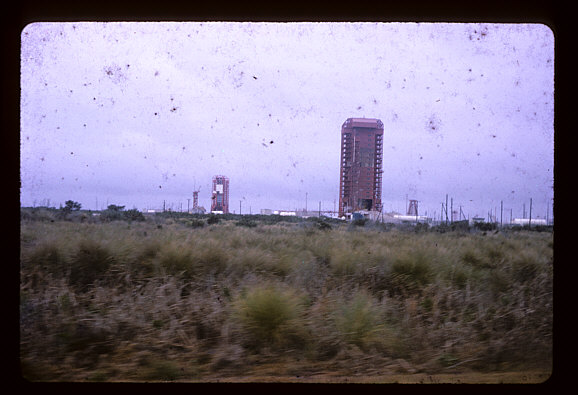
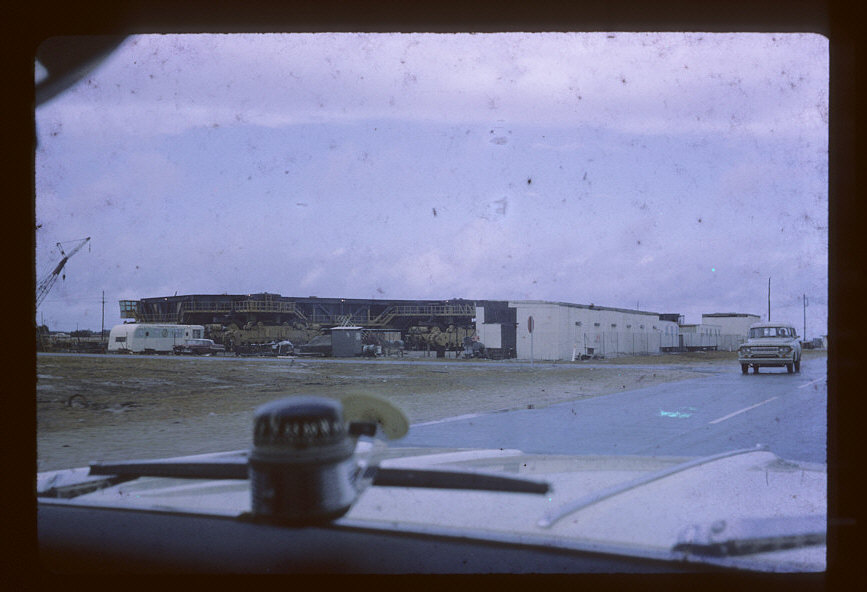
This was a surprisingly difficult view to match – in part because (I realized after I’d gotten home) the printed copy I was using as a guide cut off the right side of the image at about the right-hand side of the blockhouse mound. Obviously, the receding lines aren’t going to match up when you’re actually a few feet to one side of where you should be. I also had trouble with the height – judging from the crossbar on the monument, I didn’t crouch down far enough to simulate a chest-height slide camera. The people next to the monument are strangers, but the guy on the left looks a lot like my father – I sure would like to know what happened the pictures he was apparently taking at the time. There are three more old slides that I couldn’t match up, unfortunately. Two are similar views on rocket row, showing two identical service towers emerging above nearby foliage…I could never figure out for certain which towers they were (Titans, I believe, but it’s not clear which pads), and there’s not enough other detail in the slide to figure out where to go nowadays to replicate the shot. The third image was of the second crawler-transporter under construction (mostly done, with the treads missing)…I was able to find several shots of the area from different angles in NASA’s Moonport history document, but nothing showing for certain where the crawler and nearby buildings were relative to still-existing structures. I suspect they were in the area near OPF3 where the TPS shop and Ares MLP construction area are today. UPDATE: Actually, the two identical towers might have been LC36A/B. The shape of the service structure certainly looks right. Looks like India’s Chandrayaan I lunar probe has died, after a pretty good run.
315 days. Darned good for newcomers. John Scalzi takes on the bad science/design of the Star Trek franchise. I actually used to like ST:TNG when it was first broadcast. Nowadays, I find any manifestation of the franchise insufferable. Bad acting, lazy writing, trite speechifying, cross-episode amnesia re:new discoveries/innovations, Patrick Stewart, etc. That said, I caught a bit of Star Wars: Episode I in the hotel on Monday evening. I thought it was pretty weak when I saw it in the theater, but seeing it again made me cringe over how godawful it really was. The “Ewan MacGregor Jinx” was strong with that one. I’ve only had time this week to put together two comparison shots between my grandparents’ 1965 slides from KSC and my own from last week, but here they are. Unfortunately, I’m going to be too busy this coming week to do the rest any time soon – suffice to say there’s a couple more interesting ones, like LC-34 and LC-14 (with the Mercury monument). The VAB, as seen from halfway through the turn onto the street leading into the complex. As I was driving, I had to make do with a shot somewhat further back rather than risking it during the turn with other cars present. The low office building on the right is used by the Shuttle program.
The crawlerway between the VAB and OPFs 1 and 2. In the “today” picture, the highbay on the left is used for storage and staging of ETs and SRBs (and contained components of Ares-1x when I visited last week), and the one on the right is the “safe haven”.
Thanks to Jon Caldara and Independence Institute’s latest video on health reform, I have now created probably the last blog post title I would have ever expected to use. Yeah, I know: short trip. According to Bruce Gagnon, NASA’s upcoming LCROSS “moon bombing” is a test of first-strike space weapons. No…seriously…he actually believes this.
Words fail. Practice makes perfect, I guess – behold Roland Emmerich’s latest end-of-the-world apocacataclysmageddovaganza: Vatican City? That’s innovative. Even Godzilla didn’t wreck Vatican City! And while everyone jokes about an earthquake sending California sliding off into the sea, has anyone actually showed it before? Nice. I hadn’t realized from previous info that the film had “ships” of some sort in it – it isn’t clear whether these ships are spacecraft intended to flee the planet, or if they are (as hinted in glimpses) simply modern-day Noah’s Arks waiting out the catastrophe at sea. Either way, the premise one can glean from Emmerich’s trailer is vaguely similar to Martin Caidin’s 1987 SF novel Exit Earth, in which a looming planetary catastrophe triggers a similar response. Oddly enough, my copy from back in the day proclaims in bold type on the front cover, “Soon to be a Major Motion Picture!”. I’m glad in a way that “soon” wasn’t – the special effects in 1987 would have been pretty lame. Some of the scenes are also reminiscent of the old classic, When Worlds Collide, specifically the panicked mobs rushing up the ramp onto one of the aforementioned ships – perhaps it’s Emmerich’s nod to George Pal. There was some talk a couple of years back about a remake of WWC, which makes me curious as to whether this instead was the project in question. Too bad, if so – having read the book WWC was based on, I was really looking forward to a faithful new adaptation…not least because the novel’s escape spacecraft were constructed in the wilds of Michigan’s Upper Peninsula. (While the movie is considered a classic, beyond some of the effects it’s honestly pretty awful, especially given the potential of the book and its sequel.) UPDATE: Well, it turns out a remake of When Worlds Collide is in fact in the works. Spielberg is producing it, and at least judging by the writing credits at IMDB, the source material appears to be the book rather than the George Pal movie. |
|||||
|
Copyright © 2026 MarsBlog.net - All Rights Reserved Powered by WordPress & Atahualpa |
|||||