Etiam pulvinar consectetur dolor sed malesuada. Ut convallis
euismod dolor nec pretium. Nunc ut tristique massa.
Nam sodales mi vitae dolor ullamcorper et vulputate enim accumsan.
Morbi orci magna, tincidunt vitae molestie nec, molestie at mi. Nulla nulla lorem,
suscipit in posuere in, interdum non magna.
[O]ne day about a year and a half ago, [investment manager John Hantz] had a revelation. “We need scarcity,” he thought to himself as he drove past block after unoccupied block. “We can’t create opportunities, but we can create scarcity.” And that, he says one afternoon in his living room between puffs on an expensive cigar, “is how I got onto this idea of the farm.”
Yes, a farm. A large-scale, for-profit agricultural enterprise, wholly contained within the city limits of Detroit. Hantz thinksfarming could do his city a lot of good: restore big chunks of tax-delinquent, resource-draining urban blight to pastoral productivity; provide decent jobs with benefits; supply local markets and restaurants with fresh produce; attract tourists from all over the world; and — most important of all — stimulate development around the edges as the local land market tilts from stultifying abundance to something more like scarcity and investors move in. Hantz is willing to commit $30 million to the project. He’ll start with a pilot program this spring involving up to 50 acres on Detroit’s east side. “Out of the gates,” he says, “it’ll be the largest urban farm in the world.”
The original article at CNN Money features a graphic that shows these urban farms won’t just be rows of crops, oh nosirree…they’ll be something special…something cutting edge…like a cross between an O’Neill colony and a baseball stadium:
To increase the odds that they will, Hantz plans on making his farms both visually stunning and technologically cutting edge. Where there are row crops, Hantz says, they’ll be neatly organized, planted in “dead-straight lines — they may even be in a design.” But the plan isn’t to make Detroit look like Iowa. “Don’t think a farm with tractors,” says Hantz. “That’s old.”
In fact, Hantz’s operation will bear little resemblance to a traditional farm. Mike Score, who recently left Michigan State’s agricultural extension program to join Hantz Farms as president, has written a business plan that calls for the deployment of the latest in farm technology, from compost-heated greenhouses to hydroponic (water only, no soil) and aeroponic (air only) growing systems designed to maximize productivity in cramped settings. [emphasis mine]
He’s really excited about apples. Hantz Farms will use a trellised system that’s compact, highly efficient, and tourist-friendly. It won’t be like apple picking in Massachusetts, and that’s the point. Score wants visitors to Hantz Farms to see that agriculture is not just something that takes place in the countryside. They will be able to “walk down the row pushing a baby stroller,” he promises.
Which all sounds pretty silly to me, an unnecessarily capital-intensive way to accomplish the stated goal of making the land productive through agriculture – and a ridiculous exercise in subsidy seeking, as Dan notes. But on the other hand, this is not unlike what will be needed for farms on the Moon and Mars, so even if it fails (as, being in Detroit, it is foredoomed to do), it may be a valuable learning experience for future space settlement efforts.
So much for my plans for more frequent postings – new laptop or no, my folks have no internet service with which to use it.
On the other hand, they do now have satellite teevee, through which I was able to catch a few minutes of a program on Mars settlement this afternoon. I think it was a UK-produced show (the flamboyantly hip host was to all evidence British) named “Escape Earth”, which looked at (of all things) the options open to us if humanity had to leave the mother world in event of some natural or artificial global catastrophe.
Which is something of an exotic premise for a TV series, given the limited number of workable alternatives – for instance, the next episode will be about colonizing Venus, whose obvious drawbacks certainly wouldn’t make it one’s first (or even hundredth) choice of a refuge from planetary cataclysm.
But the portion of the Mars show I saw was nonetheless interesting, for instance, demonstrating some of the construction methods Bob Zubrin catalogued in “The Case For Mars” many moons ago. Unfortunately, everyone but the uber-hip host was from the list of Martian Usual Subjects, so it didn’t introduce any new faces.
Part of the reason that posting on MarsBlog has been so lackluster over the past year is that my other project, People’s Press Collective, has been claiming nearly all of my time outside of work. Since I live about forty minutes from downtown Denver, and end up down there for events 2-3 nights a week, it’s been awfully hard to find the time (or motivation when time is available) to blog from my trusty deskbound desktop PC at home.
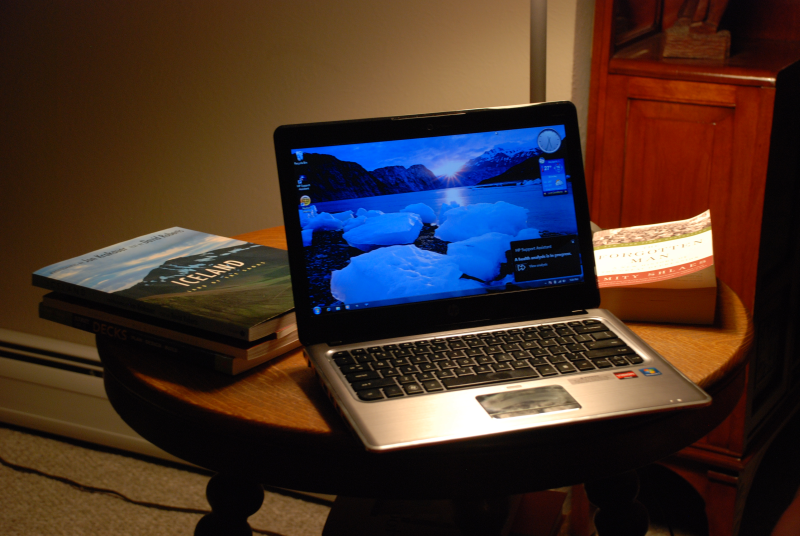
For that and other reasons, I finally invested in a new HP dm3 laptop yesterday. Or maybe it’s a netbook. I’m not really clear on the distinction, and this one seems to be in a gray zone in between, having a dual-core 64-bit processor and faster bus than an obvious netbook and a slightly larger size, but similarly missing the optical drive of a laptop and a typical laptop’s voracious appetite for battery power. Oh, and it has a slick magnesium case, which makes it look much more hardy than the toy-like netbooks (or medical-equipment-like white Apples, for that matter).
So, with any luck, this should make posting a lot easier, and thus somewhat more frequent.
While I’ve had limited time thus far to play with it (that will come in the airport this week), I have tried out some video from the HD camcorder I picked up last month, and it is truly amazing. The desktop didn’t have enough memory to view native .MT2 files without a lot of choppiness (and since it was RDRAM, was not cost-effective to expand), but the little laptop was all set up and ready to go, with all the right codecs already installed for Media Player. If you haven’t played around with HD video, it’s incredible how much sharper and more “real” it is than what you may be used to from YouTube or online television watching. I still may need to get a new desktop at some point to process video, but for viewing it, I don’t think I could ask for much better.
I finally finished scanning all 500-odd of my uncle’s old slides yesterday, and found a couple more aerospace shots in the mix, including this:
I’m not a plane expert, but I believe this is a C-124 Globemaster II. One thing that struck me about looking at the plane from this angle is the vague resemblance to the forward fuselage of a 747 — which is interesting given that the C-124 was a Douglas product.
If anyone is interested, the scanner used is a Nikon Coolscan 5000ED with the slide autofeeder attachment. I honestly can’t say enough good about the thing.
Oh, and among the slides not related to aerospace — puppies!
While visiting family in Michigan over Thanksgiving, I happened to mention to my uncle that I had bought a slide scanner a couple of years ago, and that I had scanned in my grandfather’s (his father-in-law’s) old slides from the early 1960s. This led to him dropping off a box the next day, with around 300 slides he took in the mid-1950s, for me to take home and scan for him.
A number of them are of aerospace interest, as they show various then-current planes, including a tarmac filled with C-97 Stratofreighters and a Flying Boxcar:
What I didn’t expect was this slide:
It appears to be a shot of WWII hero and actor Audie Murphy during the filming of The Guns of Fort Petticoat, a movie taglined at IMDB thus: “GOOD WOMEN…BAD WOMEN…BRAWLING WOMEN…BRAVE WOMEN! They were all soldiers in skirts! ” I cropped the slide down to about half size, but there is a boom microphone to the right and a camera in a blimp to the left (above the shoulder of the guy in the white hat).
What surprises me (and perhaps it shouldn’t) is that it took roughly 15,000 still frames to generate the film. I bought a Nikon D80 two and a half years ago, and since have taken it on two trips abroad, on two trips to Moab, up eight Fourteeners, on at least five significant hikes, four trips to Michigan, one cross-country trip, four moonbat rallies, two tea parties, and numerous other events, and still have only taken just shy of 14,000 pictures with it (not including RAW/jpeg pairs).
Whatever else good eventually comes out of the ISS, demonstrating VASIMR — and then using it to routinely reboost the station — might just be its best sci/tech achievement.
Okay, so it’s only a subset of major movies and TV shows, but this visualization of fictional time travel timelines is pretty interesting nonetheless – especially the path-crossings by unrelated time travelers and the amusing crossover movies/episodes one can imagine resulting from these “paradoxes”.