Etiam pulvinar consectetur dolor sed malesuada. Ut convallis
euismod dolor nec pretium. Nunc ut tristique massa.
Nam sodales mi vitae dolor ullamcorper et vulputate enim accumsan.
Morbi orci magna, tincidunt vitae molestie nec, molestie at mi. Nulla nulla lorem,
suscipit in posuere in, interdum non magna.
For those unfamiliar with the novel, or who may have forgotten the synopsis from the Amazon Breakthrough Novel Award entry some time back, Labyrinth of Night is a young adult science fiction novel following the struggles of Amber Jacobsen — the first and so far only child on Mars — to prove her value to the other settlers by (among other things) resolving an old and largely forgotten mystery.
In this short excerpt, Amber and her parents are camping out in their beat-up rover, as they travel from their home (one of the old tuna-can habs left behind by the early exploratory missions) to the main settlement, Port Lowell. Amber, having just turned 14 a few days earlier, is finding herself increasingly bored with life on the frontier:
Amber awoke with a start, feeling dangerously exposed under the transparent curve of the rover’s front window. She had lived all her life surrounded by walls or a suit, seeing the surface only through a small viewport or a helmet visor. This broad, clear view of the sky always made her feel vulnerable.
She wondered what time it was — just above the horizon was one of the morning stars, which the daily astronomy report said would rise about an hour before the sun. Dawn was near.
She reached out both hands towards the faintly blue star, touching her wrists together and forming a cup as if to cradle a precious jewel. “Earth”, she whispered.
One of the other things on my plate right now is putting the novel through one final edit, prior to publishing it on Kindle. We’ve tried (oh have we tried) to find an agent, but none seem interested in the genre right now…which is to say, every inquiry gets rejected out of hand, unread, with the explanation that the agent isn’t taking on new clients right now or is looking for other types of stories.
So, a few weeks back, I bought a Kindle 3G to test out the platform.
So far, I like it. It takes a little while to get used to it, but it grows on you fairly quickly. I had seen previous versions owned by friends, so I had an idea of what to expect, but I was still pretty impressed with it. The first thing that wowed me when I took it out of the box was the thinness of the thing — I was almost afraid to handle it, for fear of slicing my fingers off. The second thing was my mistaking the default display image for a printed shipping overlay — I had to look very closely at it, from several different angles, to convince myself that what I was seeing was really on the screen, such is the visual novelty of “electric paper” displays.
Turned it on, set it up in short order (added my home wifi info, which is actually optional with the 3G version), and it was ready to go. The only other setup I had to perform had to do with uploading of documents, and involved simply adding my personal email address to a list on my Amazon account so that the conversion server would accept documents sent to it from that address. With only one false try (using PDF format, which produced unsurprisingly dodgy results in formatting) I was able to upload the manuscript to my Kindle flawlessly. I had expected it to require a lot of online fussing and fixing to make it look right, but it digested the native .docx file with nary a burp.
One thing I have not yet done is paid to download any new books (for lack of time). I did download a few freebie classics I was familiar with (Machiavelli’s The Prince and Marcus Aurelius’ Meditations…not kidding about the “classics” part), and have been poking around in them as time permits since their short, self-contained chapters make them more amenable than novels to reading in small increments. The feature whereby passages highlighted by other readers are highlighted on your own screen is a nice touch — it’s like a social-media version of buying a used book at the college bookstore, with the importance of a passage indicated not merely by the electronic equivalent of underlining or a highlight pen, but also by the number of other people who thought it significant>
One thing I didn’t like about it is the way the screen flickers when you “turn the page”, but this is where that “getting used to it” thing comes in — after a few minutes, you don’t notice it.
Time permitting tomorrow, I may be able to start posting sample chapters as an appetizer for the full novel, which we expect to have available via Kindle in the next two weeks or so.
David Zucker gives Babs Boxer’s undeservedly inflated ego the skewering it so richly deserves:
Something I’ve been on the lookout for for over a year now as an addition to PPC is talent like this at the local level — film students or hobbyists who are interested in politics and motivated to make funny-but-pointed parodies of this sort. It’s something I’d love to take on, were I not already tied up with too many other commitments.
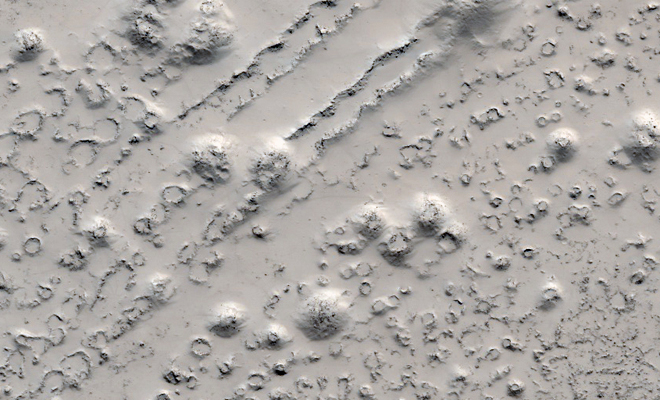
These volcanic cones were formed by hot lava running over water or ice. The heat from the lava boiled the water underneath, and the water burst upwards in an exploding bubble of lava. The explosion threw chunks of molten and solid lava into the air to gather into the cones. These cones are similar in size and shape to cones found in Iceland.
Probably because last month I saw some of the craters in Iceland referred to in the Wired article:
It’s a little hard to appreciate them from this angle – short of renting a plane or climbing the Gibraltar-like pinnacle in the middle of the lake, there wasn’t a good vantage point from which to capture on film the features you could see with your eyes (well, okay, there sorta was, but I didn’t have my long zoom lens on the trip).
As I recall, the Mars Society was at one time considering establishing one of their analogue stations in Iceland. One could certainly choose far less Mars-similar locations…
I’ve always thought that NASA’s manned rover concepts were a little too consciously “futuristic”, designed more with a sci-fi aesthetic in mind than simple rugged practicality.
The clouds and greenery (such as it is) distract from the impression here, but the geothermal taps at Krafla struck me as looking a lot like the infrastructure one might expect to see near a settlement on the Moon or Mars. The offworld resemblance wasn’t only in the incompletely-terraformed appearance of the landscape.
Since then, the X-37B been arguably the least-secret secret project on the planet, as fellow backyard astronomers joined in the scrutiny, aided by how-to video guides and apps such as the Simple Satellite Tracker.
That is, they did until July 29, when the shuttle disappeared, causing all kinds of consternation and conspiracy theories about its fate.
It took amateur skywatcher Greg Roberts of Cape Town, South Africa, who noticed that it failed to appear as scheduled above his base on August 14, another five days to find it.
When he did, he noticed it was some 30km higher and on a different trajectory, according to calculations from other colleagues in Rome and Oklahoma.
The X-37B’s new track means it takes six days to pass the same spot on Earth, as opposed to its original four-day track.
So it can maneuver, which is interesting but not unexpected. The hype, though, made me think of an old short story from Analog, Jerry Oltion’s “The Getaway Special”
A certified Mad Scientist invents a hyperdrive which can be built out of spare parts and can instantaneously teleport an arbitrary spherical volume of space and all it contains into a vacuum…
Because he’s immensely rich from having invented the perfect battery, he hires space on a Space Shuttle to test his drive – in a Getaway Special shuttle experiment canister – and tests it by taking the shuttle and crew on an unanticipated jaunt.