A sample text widget
Etiam pulvinar consectetur dolor sed malesuada. Ut convallis
euismod dolor nec pretium. Nunc ut tristique massa.
Nam sodales mi vitae dolor ullamcorper et vulputate enim accumsan.
Morbi orci magna, tincidunt vitae molestie nec, molestie at mi. Nulla nulla lorem,
suscipit in posuere in, interdum non magna.
|
The DART automated rendezvous technology demonstration spacecraft managed to sort-of rendezvous with its target satellite, but did not get within 17 feet of it as intended.
Good thing there’s a backup — XSS-11, a small spacecraft designed to perform similar rendezvous and proximity operations, was successfully launched on Monday. While having a slightly different focus, the XSS-11 project seems even more ambitious than DART:
During its mission, the XSS-11 craft will approach dead or unused US satellites or old rocket parts. At each rendezvous, the Air Force satellite will burn its engines to move around the object while taking a range of pictures.
Normally, ground controllers instruct a satellite when to fire its engines. But, after a commissioning and testing phase, XSS-11 will only take instruction on where to find a dead satellite. Then, with its on-board planner, it will calculate when to burn its engines…
During its lifetime, XSS-11 will rendezvous with six to eight objects, the first of which will probably be the upper stage of the Minotaur rocket that carried it into space. The Air Force wants to be able to service and inspect military satellites in space…
NASA is also interested in using such technology for a Mars-sample-return mission, so that a lander would be able to dock autonomously with a mother ship after a visit to the surface. Spacecraft autonomy is one of the requirements for President George W Bush?s plan for human missions to the Moon and Mars.
Not to mention the ability to autonomously assemble and resupply large spacecraft in orbit.
Naturally, since such a spacecraft can — like any tool — be used for destructive purposes, the development of such a capability is twisting knickers in certain quarters:
However, Theresa Hitchens, vice president for the Center for Defense Information, a think-tank in Washington, DC, says that the XSS-11 satellite could be the predecessor for a space-based weapon. If a micro-satellite could approach other satellites, she says, it could also adjust its speed and ram into the satellite, damaging it or knocking it off course. And smaller satellites are more difficult to detect from the ground. But officially, the US Air Force has no offensive satellite weapons program.
Like that’s a bad thing to have in the toolbox. Just wait until some rogue state knocks out their Link TV feed and see how quickly they change their tune.
Mark Whittington points out an interesting application of space imaging technology to archaeology.
For more than a century, it has caused excitement and frustration in equal measure – a collection of Greek and Roman writings so vast it could redraw the map of classical civilisation. If only it was legible.
Now, in a breakthrough described as the classical equivalent of finding the holy grail, Oxford University scientists have employed infra-red technology to open up the hoard, known as the Oxyrhynchus Papyri, and with it the prospect that hundreds of lost Greek comedies, tragedies and epic poems will soon be revealed.
In the past four days alone, Oxford’s classicists have used it to make a series of astonishing discoveries, including writing by Sophocles, Euripides, Hesiod and other literary giants of the ancient world, lost for millennia. They even believe they are likely to find lost Christian gospels, the originals of which were written around the time of the earliest books of the New Testament.
Recovery of ancient texts via infrared scanning — brought to you by the mad scientists of the dreaded Military Industrial Complex™!
(And is it just me, or is there a striking similarity between this story and the technical premise of James P. Hogan’s Inherit the Stars?)
Bruce is complaining about nukes in space again.
Nothing much new to lampoon here, just the usual conspiracy mongering and allusions to unnamed alternatives to nuclear power for deep-space missions. However, I did notice a couple of factual errors in his letter.
Local police forces were heard on National Public Radio warning the public to stay away from Columbia debris and said they were told by NASA that “radioactive” sources were on-board that mission. Just what was the radioactive source on Columbia?
Local police may or may not have claimed that there was radioactive contamination in the Columbia wreckage, but according to NASA the only radioactive material of note aboard Columbia at the time of the wreck was the less than 11 total microcuries of Americium 242 in the orbiter’s onboard smoke detectors — not enough to have caused any illness or injury. What NASA was warning people about was the presence of residual hypergolics and other chemically toxic materials (and it’s entirely possible that even that danger was deliberately overstated so as to deter would-be souvenir collectors from pocketing pieces of the debris). While Bruce is only citing hearsay and the inaccuracy is therefore not strictly speaking his, he is citing it with the implication that it is true (indeed, the question at the end of the quoted paragraph assumes the rumor is fact).
And then there’s this assertion of fact which, in fact, isn’t factual at all:
Forgive us for not believing anything our government says. But you all have no credibility. One example is Kodiak island in Alaska. The U.S. government built a rocket launch facility there and promised the citizens of Alaska that it would only be used for civilian launches, never military. But in reality the only missions that have yet been launched have been Missile Defense Agency (MDA) tests.
[emphasis mine]
The Athena-1 launch of September 30, 2001 was not a BMDO/MDA launch, but rather a joint NASA – USAF Space Test Program launch known as “Kodiak Star”, with the Picosat, Sapphire, and PCSat technology demonstrators and Starshine 3 geodetic experiment as payloads. Oops.
Skimming this bit of the Convention on the Law of the Sea, I have to wonder whether a similar regime will be established should useful quantities of helium-3 be found on the Moon and the technology required to employ it in commercially viable fusion power generation be demonstrated.
For a resource that was trendy in the 1970s and appears to have fallen off the radar since, the LoS expresses an amount of interest in seafloor nodules that is obsessive to the point of sickness. Given the far greater economic potential of a fuel for clean fusion, one can imagine how much more greedy interested the “common heritage” crowd would be regarding He3 exploration and extraction.
Stephen Green thinks he got snow this weekend.
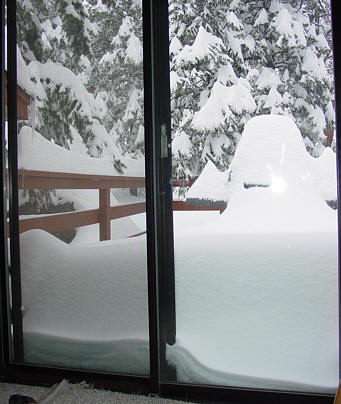
Try this…this is what greeted me when I looked out my back patio door this morning — that Tikal pyramid thing on the right is the grill, which I had been using in t-shirt and shorts Saturday afternoon:
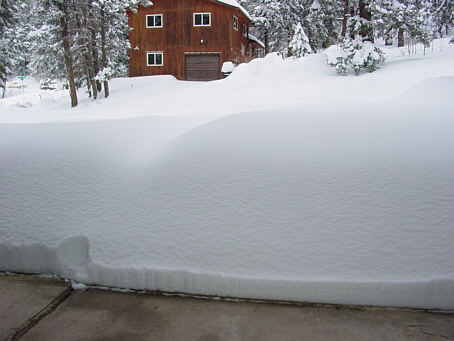
The view from the garage was just as white — that drift is right around 3ft high:
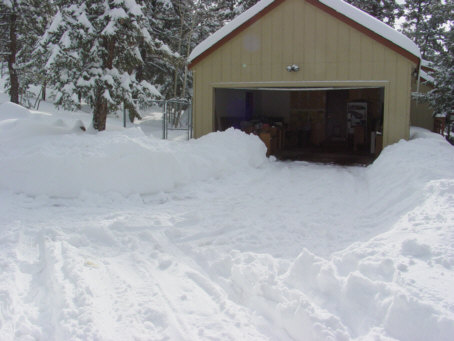
But, it’s nothing that three hours of backbreaking work with a shovel can’t fix:
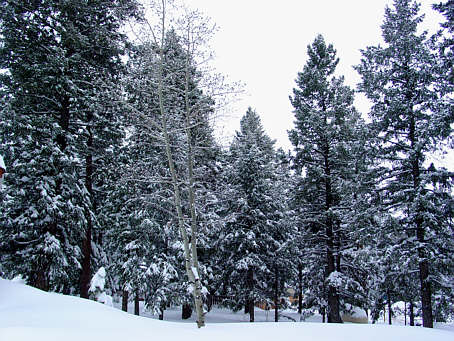
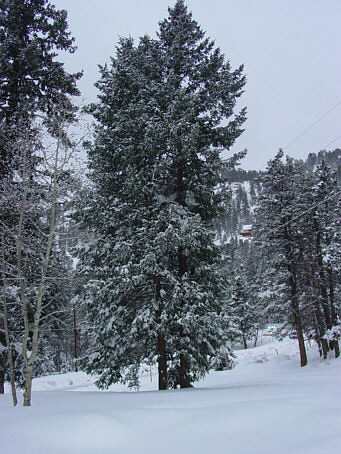
And at least I had a nice view to admire while shoveling:
I’m half tempted to go this year, but I’m not too sure about the venue.
Looks like I missed a good time this week, just down the road:
I am in Colorado Springs with our affiliate group Citizens for Peace in Space protesting the 21st annual Space Symposium at the fancy Broadmoor Hotel. Over 6,000 military personnel and aerospace industry types are gathering to plan for war in space.
First Afghanistan, then Iraq, now…Space! Well, it seems perfectly reasonable to me — if you’re going to have a doctrine of preemptive action to prevent the spread of WMD, space is the place to go. The place is littered with the the things — we need to round them up and put them to good, peaceful uses.
The theme of the protest was the symposium is a weapons of mass destruction arms bazar and that those attending practice “Group think.”
I don’t see the connection between the two elements of the theme, myself, but I’m sure to them it was quite droll.
A street theatre group had made a replica of a satellite and four people with eye glasses covered in dollar signs, $$, went round and round the satellite chanting “Group think, group think” in a dull tone.
What protest would be complete without a papier mache puppet and protestors chanting dully?
…It was quite good and the conference attendees had a good look at it.
And no doubt a few laughs, as well.
…Today we go back to the symposium for more vigiling [is that even a word? — Ed.] and then tonight I speak in Denver. On Wednesday I will be in Boulder to speak. Back home on Thursday.
Sigh. Looks like I missed my opportunity to see Bruce in person — oh, what a fun post a live appearance would have yielded. Maybe next time.
Is it already that time again?
Rocky Mountain Blogger Bash 4.0
(And just what were Stephen and Walter doing with that llama?)
An excellent review of the reasons for expanding nuclear power — something that’s sure to put the luddites’ Birkenstocks in a bind: Why the U.S. Needs More Nuclear Power
Astonishingly, over this same period, uranium?s share of U.S. electricity has also risen?from 11 percent to its current 20 percent. Part of the explanation is more nuclear power plants. Even though Three Mile Island put an end to the commissioning of new facilities, some already under construction at the time later opened, with the plant count peaking at 112 in 1990. Three Mile Island also impelled plant operators to develop systematic procedures for sharing information and expertise, and plants that used to run seven months per year now run almost eleven. Uranium has thus displaced about eight percentage points of oil, and five points of hydroelectric, in the expanding electricity market.
Renewable fuels, by contrast, made no visible dent in energy supplies, despite the hopes of Greens and the benefits of government-funded research, subsidies, and tax breaks. About a half billion kWh of electricity came from solar power in 2002 – roughly 0.013 percent of the U.S. total. Wind power contributed another 0.27 percent. Fossil and nuclear fuels still completely dominate the U.S. energy supply, as in all industrialized economies…
No conceivable mix of solar and wind could come close to supplying the trillions of additional kilowatt-hours of power we?ll soon need.
Nuclear power could do it?easily. In all key technical respects, it is the antithesis of solar power. A quad?s worth of solar-powered wood is a huge forest?beautiful to behold, but bulky and heavy. Pound for pound, coal stores about twice as much heat. Oil beats coal by about twice as much again. And an ounce of enriched-uranium fuel equals about 4 tons of coal, or 15 barrels of oil. That?s why minuscule quantities contained in relatively tiny reactors can power a metropolis.
What?s more, North America has vast deposits of uranium ore, and scooping it up is no real challenge. Enrichment accounts for about half of the fuel?s cost, and enrichment technologies keep improving. Proponents of solar and wind power maintain?correctly?that the underlying technologies for these energy sources keep getting cheaper, but so do those that squeeze power out of conventional fuels. The lasers coming out of the same semiconductor fabs that build solar cells could enrich uranium a thousand times more efficiently than the gaseous-diffusion processes currently used.
And we also know this: left to its own devices, the market has not pursued thin, low-energy-density fuels, however cheap, but has instead paid steep premiums for fuels that pack more energy into less weight and space, and for power plants that pump greater power out of smaller engines, furnaces, generators, reactors, and turbines. Until the 1970s, engineering and economic imperatives had been pushing the fuel mix inexorably up the power-density curve, from wood to coal to oil to uranium. And the same held true on the demand side, with consumers steadily shifting toward fuels carrying more power, delivered faster, in less space.
But what about safety? Contrary to the stupid, stupid premise of the current season of 24,
Today?s plants split atoms behind super-thick layers of steel and concrete; future plants would boast thicker protection still. All the numbers, and the strong consensus in the technical community, reinforce the projections made two decades ago: it is extremely unlikely that there will ever be a serious release of nuclear materials from a U.S. reactor.
Read the whole thing.
[via Carl Carlsson]
Branson to take first tourist into space
41-year old Doug Ramsburg, from Denver, Colorado, will rocket into space in a few years time when Virgin’s fleet of spaceships will be ready…
Ramsburg was one of 135,000 entrants in a contest run by Volvo and Virgin, to launch a new Volvo car. Ramsburg gets the trip for free, but other hopefuls will have to pay ?107,000 ($200,000) for a seat on one of the Virgin Galactic ships.
|
|