A sample text widget
Etiam pulvinar consectetur dolor sed malesuada. Ut convallis
euismod dolor nec pretium. Nunc ut tristique massa.
Nam sodales mi vitae dolor ullamcorper et vulputate enim accumsan.
Morbi orci magna, tincidunt vitae molestie nec, molestie at mi. Nulla nulla lorem,
suscipit in posuere in, interdum non magna.
|
Space Adventures is now selling spacewalks as an add-on for its ISS tourist missions. What’s interesting about this is not the fact that they’re doing it, but why:
So far, three civilian men have paid their way to the ISS, but their 10-day pleasure cruises were confined to the pressurised hulls of the Soyuz and the station.
When they returned to Earth, they said they would have liked to have done a spacewalk, where the only thing separating them from the vacuum of space is a visor, says Space Adventures spokesperson Stacey Tearne.
In other words, SA is adding the spacewalk option because their previous customers expressed a desire for it — customer demand is driving the improvement/expansion of an existing service.
I love capitalism!
I wonder, though, how this add-on option will fare once Bigelow has its full-scale inflatable modules in service. No, floating about in an enormous empty volume is not the same thing as spacewalking, and you don’t get much of a view from inside an orbital balloon, but considering how much less expensive it would be for a similar sense of gravitational freedom (with the bonus of not needing a cumbersome pressure suit and all that goes with it), I would imagine it would be attractive as an affordable substitute.
On the other hand…if orbital space tourism really takes off, and there is enough of a market for spacewalks (even from cavernous Bigelow inflatables), it could drive the development of better suits. Reducing the time and effort required to prepare for and clean up after an EVA and extending the EVA’s duration would not only make the service more operationally attractive to potential customers but also reduce the cost of the service and therefore its price. If they’re made easier to conduct and less expensive, more spacewalks will be sold…which is also true of access to orbit.
Rand Simberg has been liveblogging all weekend from the Space Frontier Conference in Las Vegas. (Start here and scroll up.)
It’s almost like being there…without having to pay for travel, lodging, and conference fees. Thanks, Rand!
Dr. Sanity seems to be describing our favorite moonbat peacenik:
War is a always a terrible choice. No reasonable person could believe that it is benign or intrinsically “good” to wage war. Yet, it is sometimes a choice that reasonable people need to make simply because evil exists in the world and it cannot go unchecked–that is, not if you truly care about innocent human life.
Pacifists cannot deal with this simple truth. In reality, they don’t care much about human suffering, misery or even death; let alone the legacy of evil in the world. Through a variety of psychological defenses, they have managed to deny, displace, distort, and project real evil away. There cannot be found even a trace of psychological insight among all those angry marchers who violently and adamantly demand peace at any price.
For the carefree members of the antiwar movement, the triumph of evil is unimportant when compared to their own narcissistic need to appear virtuous and good.
Pacifism–what is it good for? It protects the user from having to make difficult moral choices in the real world; from having to deal with real human suffering in the here and now; and most importantly, from recognizing how meaningless their own lives are.
The track record of pacifism is horrendous. Not only do “peace movements” fail to bring peace; but by protecting, appeasing, and minimizing true evil, they ensure that war–when it inevitably comes–costs even more in terms of human suffering and lives.
As promised, Aaron, here are your taunting pictures of a non-flat landscape:
Mt. Democrat:

Wheeler Mountain, North Star Mountain, and Quandary Peak to the north of Mt. Cameron/Mt. Lincoln, with Wheeler Lake in the middle:

Mt. Lincoln:

Technology that will be useful for eventual human settlement of space continues to develop: Australian research shows microbes may turn dust into gold
A group of scientists led by German-born researcher Frank Reith collected gold grains from two Australian mines more than 3,000 kilometers (1,900 miles) apart, and discovered that 80 percent of the grains had the bacteria living on them.
”What we found out suggests that bacteria can accumulate this gold,” Reith told The Associated Press in a telephone interview from his Australian office on Friday.
Reith said Ralstonia metallidurans act as microscopic soil scrubbers, soaking up heavy metals in their dissolved form and converting them into less toxic, solid forms.
I expect that someday in the not-too-distant future, technology developed from findings like this will account for a sizeable portion of the raw material inputs to industry. Not only is it useful in space, where it could be used in place of the energy- and labor-intensive processes used on Earth, but it is also useful on Earth for such things as brownfield remediation and (eventually) landfill reclamation…turning garbage to gold, literally and metaphorically.
When I first started reading this article, it sounded like good material for a post on the ongoing withering of the “giggle factor” regarding space settlement and commerce.
After reading the whole thing, though, I see that both the article and its subject actually reinforce the giggle factor:
The mother-of-two is a huge fan of the science-fiction television and film series “Star Trek”.
“I am really into sci-fi and horror so I really want to go to a big Trekkie convention in the US and dress up,” she confessed.
“I have always been fascinated with stars and space so I’m going to get a strong telescope in my garden.”
She admitted: “I am a bit of a geek”.
Star Trek? Trekkie convention? Sigh.
Space News reported last week (July 7 — sorry, no link available) that ILS would no longer be competing for launches of satellites less than 4500kg. Apparently this is because the lower end of the launch market offers insufficient return on investment — at least for ILS.
What’s interesting about this is that it’s the same market that SpaceX is after with the Falcon 5/9, as well as the Kistler K-1. Less competition from the Usual Suspects means more opportunities for the newcomers.
Great. It may be time to stop procrastinating and buy a gun.
This should hardly be a surprise. I’m only about fifteen miles up the road from Evergreen, and even two years ago when I moved here, I was told that cats and small dogs should be considered “disposable household accessories” since they so frequently disappear. (Into the bellies of big cats, one was left to infer.)
(And what kind of cruel mother names her son “Schylure”? Yeesh.)
Score another milestone on the way to a private/commercial spaceflight industry:Inflatable Satellite Launches in Russia
A converted missile blasted off Wednesday carrying an experimental inflatable spacecraft for an American entrepreneur who dreams of some day building a commercial space station, officials said.
The Genesis I spacecraft lifted off from Russia’s southern Ural Mountains at 6:53 p.m. Moscow time aboard a Dnepr rocket converted from a Cold War ballistic missile, according to the Russian Strategic Missile Forces…
The launch was a first for Bigelow Aerospace, founded by Las Vegas real estate mogul Robert Bigelow, who owns the Budget Suites of America hotel chain.
Bigelow envisions building a private orbiting space complex by 2015 that would be made up of several expandable Genesis-like modules linked together and could be used as a hotel, or perhaps a science lab or college. He has committed $500 million toward the project.
Excellent.
Just imagine — if one of the manned startups makes it to orbit, in a decade (or sooner) we could have private manned spacecraft servicing private space stations for an investment of less than a billion dollars. At least if you go by the amount various entrepreneurs claim to be willing to commit — it’s doubtful that there wouldn’t be unanticipated costs between here and there, but on the bright side, how bad can it be when compared to NASA’s record for such things? If startups end up spending $3-5 billion to get to that point, they’ll still have spent less than NASA has on RTF alone.
I intended to do another “Why I Like Living in Colorado” photoessay last week, after my latest attempt to climb Mt. Massive, but I got distracted with other things and in the end didn’t really have a lot of pictures to work with…plenty of good pictures, but they all sorta look alike. So, here’s one of the gazillion columbines that were in bloom last weekend, before the monsoon arrived:

And here’s one of the nice but repetetive shots of the view from the trail:
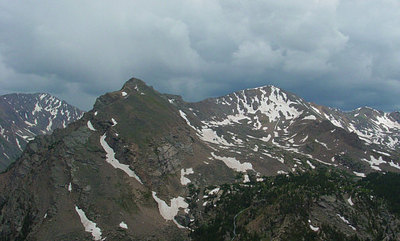
Those dark clouds moving in were what forced us to abort shortly after this was taken. And none too soon, as we ended up jogging the last mile or so back to the car, with lightning overhead and rain starting to fall.
|
|