Archives

A sample text widget

Etiam pulvinar consectetur dolor sed malesuada. Ut convallis euismod dolor nec pretium. Nunc ut tristique massa.

Nam sodales mi vitae dolor ullamcorper et vulputate enim accumsan. Morbi orci magna, tincidunt vitae molestie nec, molestie at mi. Nulla nulla lorem, suscipit in posuere in, interdum non magna.

NO TECHNOCRATS IN SPACE: John Carter McKnight has a new essay out: Lawmen, Taxmen and Bureaucrats:

We have plenty of status quo here on Earth – it hardly seems necessary to go to great expense to vacuum-pack it.

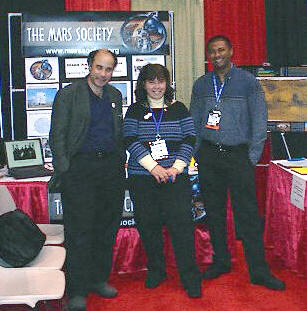
PHOTOS FROM THE WSC: Carl Carlsson sends a couple of photos taken at the Mars Society’s booth at the World Space Congress on Monday.


Carl with Bob Zubrin and Rocky Persaud.


Bob Zubrin, Patt Czarnik, and Rocky Persaud.

NOT SURE WHAT TO MAKE OF THIS: The Mars Institute has made its debut at the World Space Congress in Houston.

Should this be interpreted as the creation of a new organization which will focus on the space science related to Mars, a collection of greybeards to provide peer review and direction to Mars exploration and thus give some structure and, er, “respectability” to it?

Or should it be interpreted as a mass defection from the Mars Society?

I notice among the list of officers a number of people associated (or formerly associated, perhaps) with the MS, but I have no idea if they plan to work with both organizations or only with the new one. If the latter, this could be a serious blow to the science side of MS (I’d not be too disappointed to see Kim Stanley Robinson depart, as I find his views rather irritating and the near-worship of his books among MSers annoying).

I hope it hasn’t come to this, but if it has anyone can probably guess the reasons behind it.

TODAY’S THEMIS IMAGE: Appollinaris Patera

This THEMIS image shows parts of the dissected and eroded remnants of an impact crater rim and volcanic material located north of Apollinaris Patera near the southern highlands – northern lowlands dichotomy on Mars. The rugged terrain observed in the context image of the region has been interpreted as lava flows interbedded with eolian or volcanic pyroclastics while the more smooth terrain has been interpreted as ancient channel deposits. The high resolution THEMIS image shows the effects of erosion on these materials as parts of the rim have been dissected into a chaotic terrain. Smaller and heavily eroded impact craters are also observed in the image and are evidence of the powerful effects of erosion.

MONDAY’S THEMIS IMAGE: Hesperia Planum

This image is located in the eastern portion of a region on Mars called Hesperia Planum, which is in the cratered southern highlands of Mars. Immediately visible in the image is the dark barchan type dunes that are being blown against the southeast wall of the crater. The position of the dunes in the crater as well as the southeast facing slipfaces on the dunes indicate that the local winds blow primarily towards the southeast. An interesting aspect of this image is the relatively brighter ripple like features that are visible just to the southeast of the dune field. These features are smaller than the dark dunes, but can be clearly seen in the full resolution image. Wind processes also probably formed these features and their orientation also indicates a northwest-southeast wind direction. It is not clear if these features are actively being formed by the wind or if they were only active at some point in the Martian past. Mars is a very dry, desert-like environment and the wind plays a very important role in shaping the present landscape.

REMODELING: As should be obvious, I’m doing a bit of redesign on the site (the blog as well as the LAMS website behind it). Partly trying to get things up-to-date, partly trying to keep up with all the big-time bloggers who have done away with their klunky Blogger templates in favor of sleek professional designs.

I’m not a professional web designer, so, you get what you get. But I think it already looks worlds better than before.

If it looks to you like something is broken, please let me know — I’m transferring it to FP2002, which sometimes produces code that does weird things to Netscape 4.x browsers (imagine that). Also, if you’ve bookmarked directly to the file “blogger.html”, you’ll want to change over to the generic home page now.

OOH, PRETTY: A composite MOLA/Viking image of Argyre Basin.

It’s almost like being there. In orbit, anyway.

TODAY’S THEMIS IMAGE: Giant pimples on Arcadia Planitia

This THEMIS image of rounded hills and ridges in Arcadia Planitia shows a very intriguing geomorphic feature that may be attributed to the presence of an icy-rock mixture of material. Smooth aprons of material are observed to be preferentially located on the cold, north facing slopes of hills and extend further and beyond the deposits located on other sides. These smooth deposits are in stark contrast to the more rough surfaces that dominate the scene and it has been suggested that they represent a preserved mixture of ice and rock. How exactly this deposit forms still remains a mystery. They may have been ?pasted? onto the slopes and preserved on the cold facing sides or they may represent the result of downslope motion of material that is enhanced by the presence of ground ice. In either case, this interesting observation suggests that ground ice may still play an important role in the formation and preservation of martian surface features

YESTERDAY’S THEMIS IMAGE: Henry Crater

Located in Arabia Terra, the crater shown here is known as Henry Crater. Like many other craters on Mars, the interior of Henry Crater is filled with a layered deposit. These materials were brought into the crater sometime after the impact formed the crater. The fine scale of layering can be seen in the right- center portion of the image

NOW AVAILABLE: The Business Week editorial I referred to a few days ago is now available online.